

Strengthening Strategic Capabilities. Developmental Practices for CEOs
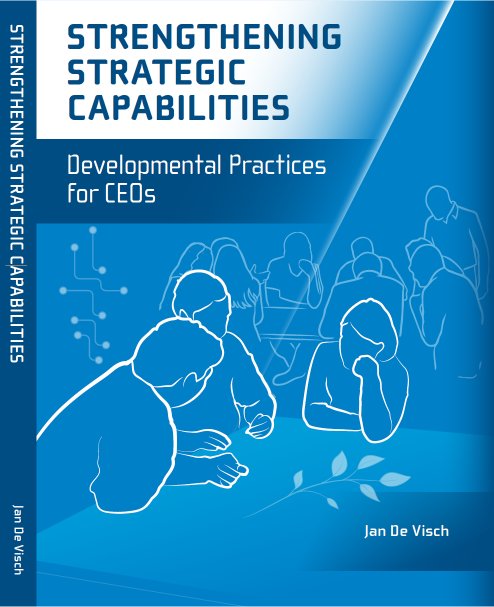
The book is available in bookshops and online retail platforms.
- What is the book about?
How can organizations become capable of realizing the future they envision?
Many organizations have ambitious strategies, talented leaders, and sophisticated management systems. Yet they struggle to translate strategic intentions into meaningful results.
Why? Because strategic success depends on more than making the right choices. It also depends on whether people, teams, roles, decision-making structures, and governance arrangements can handle the complexity those choices create.
Strengthening Strategic Capabilities introduces developmental practice as a strategic leadership capability. It explores how leaders can develop the capacity to perceive more of reality, think beyond familiar assumptions, navigate competing demands, and organize collaboration around future value creation.
Bringing together adult developmental psychology, systems thinking, and organizational design, the book examines pressing leadership challenges: performance, collaboration, AI-driven decision-making, organizational transformation, regenerative value creation, and governance.
At its heart lies one question:
What must develop—within people, teams, and the organization itself—for strategy to become reality?
- Who is this book for?
This book is written primarily for CEOs, business owners, and senior executives who recognize that conventional approaches to strategy execution, organizational change, and leadership development are no longer sufficient.
It is particularly relevant for leaders who:
- Face growing complexity and interdependencies across their organizations.
- Want to strengthen strategic thinking and collective decision-making.
- Struggle to translate strategic ambitions into organizational capabilities.
- Need to rethink responsibilities, collaboration, and governance.
- Seek to integrate AI without weakening human judgment and accountability.
- Want to create sustainable and regenerative value beyond short-term performance.
The book will also interest board members, organizational consultants, executive coaches, HR leaders, and developmental practitioners seeking to connect human development with strategic organizational challenges.
- Why this book?
Because organizations are changing faster than their capacity to understand and manage that change.
AI is transforming how work is performed and where decisions are made. Collaboration increasingly crosses organizational boundaries. Strategic transformation challenges established identities and ways of working. Sustainability and regeneration demand fundamentally different perspectives on value creation.
Yet organizations frequently respond with familiar solutions: new strategies, additional KPIs, redesigned structures, leadership training, or more sophisticated technologies.
These interventions can be useful. But they often overlook a more fundamental issue: the gap between the complexity an organization faces and the developmental capacities available to address it.
This book grew out of decades of organizational consulting and developmental practice, as well as the conversations that followed the publication of The Developmental Practitioner: Otto Laske’s Legacy on Becoming in 2025.
Where that book explored the developmental foundations of professional practice, this new publication addresses their strategic implications for CEOs.
It makes the case that developing strategic capabilities is not an optional addition to leadership. It is increasingly central to the CEO’s responsibility.
- What makes this book different?
Most books on strategic thinking focus on how leaders can think better. This book goes further: it explores how leaders can build organizations capable of thinking, deciding, and acting at higher levels of complexity.
Its distinctive contribution lies in four shifts of perspective.
From strategic thinking to developmental capacity. Strategic thinking is not treated simply as a set of analytical skills. The book examines how people construct meaning, interpret complexity, exercise judgment, and develop the capacity to hold competing perspectives.
From individual leadership to organizational architecture. Rather than concentrating exclusively on the CEO’s mindset or competencies, the book connects development to the design of roles, responsibilities, decision rights, performance systems, and governance.
From solving problems to questioning how problems are framed. Leaders frequently address the wrong problem because they define organizational boundaries too narrowly or return to familiar interpretations. The book shows how developmental inquiry can reveal what conventional analysis overlooks.
From strategy execution to future value creation. The ultimate challenge is not simply implementing an existing strategy more effectively. It is developing the human and collective capabilities through which new business models, stronger ecosystems, responsible AI, and regenerative futures become possible.
The result is a different understanding of strategic leadership: the CEO as a developmental practitioner, responsible not only for strategic direction but also for creating the conditions in which the organization can grow into its future.
- What is the practical use?
This is not simply a theoretical exploration of adult development. It is a practice-oriented book built around recognizable leadership dilemmas, anonymized organizational cases, practical frameworks, and questions that CEOs can bring directly into executive conversations.
Readers will discover how to:
- Diagnose performance problems more accurately by distinguishing individual limitations from mismatches between people, roles, organizational systems, and time horizons.
- Strengthen strategic collaboration by helping leadership teams move beyond familiar solutions and engage with the level of complexity a problem actually requires.
- Redesign responsibilities and governance around the distinctive contributions different roles and organizational levels must make.
- Preserve human judgment in AI-driven organizations by identifying where decision-making responsibility moves as AI takes over more analytical work.
- Lead transformation without losing organizational integrity by changing structures and practices while strengthening the promises on which stakeholder trust depends.
- Build capabilities for regenerative value creation by recognizing forms of value, interdependence, and long-term vitality that conventional performance indicators often overlook.
Frameworks such as the Developmental Practice Triangle, Developmental Performance Architecture, Boundary-Making Ladder, and Developmental Selection Ladder help turn these insights into concrete leadership conversations and organizational interventions.
The chapters can be read sequentially or used individually as perspectives on specific strategic challenges.
- Why should you read it?
Because the future of your organization depends not only on the strategy you choose, but on the capabilities you develop to make that future possible.
This book invites you to question assumptions that often remain invisible in executive decision-making. It will help you recognize when a performance problem is actually an organizational design problem, when collaboration conceals limited thinking, when AI changes the location of responsibility, and when transformation requires a deeper reconsideration of what creates value.
Above all, it offers a different way of approaching your role as CEO.
Not as the person who must have all the answers, but as the leader who creates the conditions for the organization to see more, think more deeply, exercise better judgment, and act with greater responsibility.
If you want to move beyond improving strategy execution toward strengthening your organization’s capacity to create its own future, this book is for you.
The challenge is no longer simply to build a better strategy. It is to build an organization capable of becoming what its strategy demands.